




Content Marketing Vs Content Strategy
If you’ve ever sat down to create content and thought,
“Okay… but what am I actually supposed to post?” — you’re not alone.
Most business owners are told they need content marketing, but no one explains how that’s different from content strategy. So they post inconsistently, try random ideas, and wonder why nothing seems to stick.
Let’s break this down.
In this post, you’ll learn:
- What content marketing actually is
- What content strategy is (and why it matters more than you think)
- The key differences between the two
- How combining them makes content feel simpler — not harder
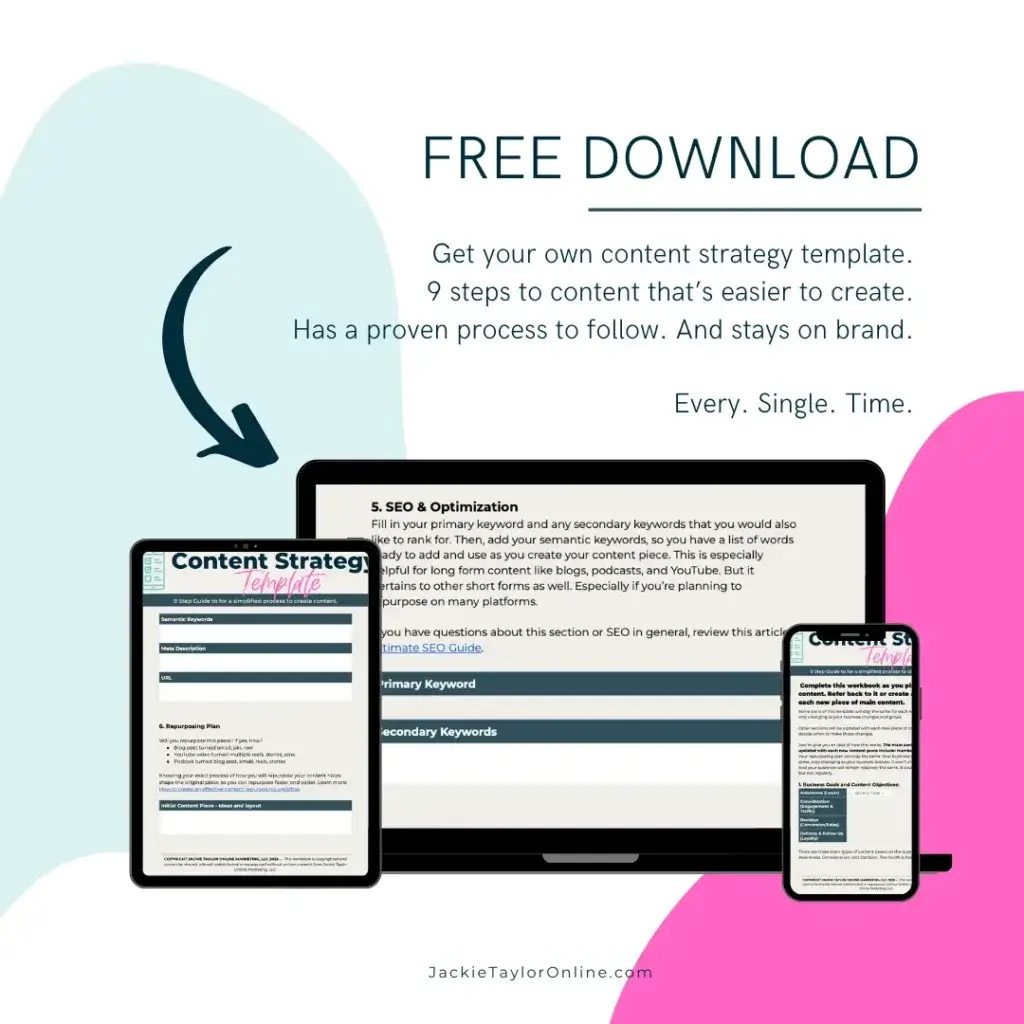
By the end, you’ll know exactly what you’re missing and how to fix it. Plus, there’s a free download – Content Strategy Template at the end.
Table of Contents
Pin it on Pinterest!
What Is Content Marketing?
Content marketing is the doing part of content.
It’s the blogs you write.
The emails you send.
The Instagram posts, videos, podcasts, and pins you publish.
The goal of content marketing is to:
- Build trust
- Create connection
- Attract the right people
- Gently guide them toward your offers
Instead of constantly selling, content marketing focuses on being helpful, relatable, and valuable.
It’s no fluff content. You still have a purpose and reason for creating the content. But you aren’t constantly pushing sales on people.
What Content Marketing Looks Like in Real Life
Some common examples of what content marketing looks like in real life:
- A blog post answering a common client question
- An Instagram carousel teaching one quick tip
- A weekly email sharing a lesson or reminder
- A video walking through a simple process
All of this is content marketing.
Related Article: Types of Content Marketing – Why it’s important to your business.
Why Storytelling Matters Here
Great content marketing isn’t about being flashy.
It’s about being clear and human. Not robotic, ChatGPT sentences that all start with those cringe, “ly words” like “Similarly, Consequently, Accordingly, Subsequently. Or even Moreover, Furthermore, However, Therefore, Nevertheless.
Talk like you would if you were trying to explain to your best friend what you business is about. And why you wish more of your target audience would find you. What is it that you can help them with the most?
Storytelling helps your audience feel seen. It builds trust. And it reminds people there’s a real person behind the brand — not just a business trying to sell something. Or a person trying to make ChatGPT do all the heavy lifting.
Related Article: The Power of Storytelling
What Is Content Strategy?
Now here’s where most people get stuck.
Content strategy is the plan behind the content.
It answers questions like:
- Who am I creating content for?
- What do they need right now?
- What’s the goal of this content?
- Where should it be shared?
- How does this support my business?
If content marketing is what you create, content strategy is why and how you create it.
The Simple Difference
Here’s the easiest way to think about it:
- Content strategy = the roadmap
- Content marketing = the road trip
You can create content without a strategy…
But it usually feels scattered, exhausting, and inconsistent.
It’s like traveling and feeling like you’re constantly lost. Because you are! You don’t have a purpose or a plan for why you’re going in that direction.
Why Research and Data Matter
A strong content strategy is based on:
- Your audience’s real questions
- What content is already working
- What offers are already selling (if any)
- What leads to sales or engagement
This doesn’t mean complicated analytics. It just means paying attention to what you see bringing in traffic. What you notice is actually making sales already.
Sometimes, it’s the most simple item that you think won’t sell. The one you think no one wants because it seems so simple.
It means paying attention and creating content on purpose. Always have a reason for the work that you’re doing and the content that you’re putting out into the world.
No purpose, means no reason to create that content in the first place.
Related Article: Why Content Creation Feels Hard (And What to Fix First)
The Content Strategy Framework
You don’t need a 50-page document to have an effective content strategy.
You just need a clear plan.
Here’s a simple framework you can use.
Step 1: Get Clear on Your Goal
Ask yourself:
- Is this content meant to educate?
- Build trust?
- Drive traffic?
- Support a specific offer?
One goal per piece of content is enough.
Step 2: Know Who You’re Talking To
Be specific.
- What are they struggling with?
- What feels confusing or overwhelming?
- What do they want to feel confident about?
Write like you’re helping one person, not everyone. Trying to help everyone with each piece of content makes it feel scattered, hard to follow, and just plain overwhelming.
Simplify, and then simplify some more.
It’s your topic of expertise. It should feel oversimplified to you for your audience to actually understand it. Remember, they aren’t where you are. They could be complete newbies.
Step 3: Choose the Right Content Type
You don’t need to be everywhere.
Pick formats that feel manageable:
- Blog posts
- Emails
- Social posts
- Short videos
Consistency matters more than volume. If you like blogging, stick to blogging. Maybe create shortened versions to send in emails and link to the full blog. And just stick with that.
If you like creating videos or being on social media instead, then try reels and carousel posts on Instagram. Repurpose those to other platforms like Pinterest or TikTok, if you have the time.
You can choose to be on social media or skip social media altogether.
All platforms works. It’s about making sure you audience is on that platform, (social media, Pinterest, blogs, YouTube, etc.) and then making sure you can keep up with creating that type of content.
Step 4: Decide Where It Lives
Decide where your content will live. Which online platform will you choose? Social media (TikTok, Instagram, Facebook, etc.), Podcast, YouTube, Pinterest, Website/Blog? Which is best?
Ask yourself:
- Where does my audience already hang out?
- Where does this content make the most sense?
- Which one do I like the best as a user?
- Can I consistently create content for this platform?
One main platform is enough to start. Adding on more can come later.
You wouldn’t learn to ride a horse by jumping on a horse and trying to learn to jump, then switching to barrel racing, and then immediately trying to learn Dressage. You would first conquer riding in general and simplying staying on the horse.
Start small and move on when you’re ready.
Step 5: Repeat What Works
Keep doing what’s working. And do less of what doesn’t. I know, it’s such a novel idea. But it really is that simple. Your audience will tell you what they want. You just have to listen and pay attention.
And you don’t have to be an experienced data scientist to read your online analytics.
Pay attention to these areas:
- What gets saved
- What gets replies
- What leads to sales or conversations
- What gets click throughs
Then do more of that. It really is that simple.
Want a more indepth dive into my content roadmap? Check out: Content Strategy Framework – Broken down step-by-step, so it’s as easy as ABC.
The Power of Combining Content Marketing and Content Strategy
This is where everything gets easier. How are they interlinked? How do they combine to make up your overall digital marketing plan?
When content strategy and content marketing work together:
- You stop guessing what to post
- Content feels more aligned
- You save time and energy
- Your message becomes clearer
Your strategy tells you what to create. Your content marketing brings it to life.
And your life feels less complicated and more peaceful.
Why This Combo Works So Well
Strategy gives you direction. Marketing gives you connection.
Together, they help you:
- Stay consistent
- Build trust faster
- Look more in control and polished as a business owner
- Create content that actually supports your business – aka actual sales
And yes — successful brands do this all the time.
The difference? They plan first, then create with intention and purpose.
Key Content Takeaways
Let’s recap:
- Content marketing is the content you create and share
- Content strategy is the plan behind it
- One without the other leads to burnout
- Together, they create clarity, consistency, and confidence
You don’t need more content.
You need a clearer plan. So you can peacefully and successfully execute that plan.
Share it on Pinterest!
Creating Your Own Content Strategy
Now I want to hear from you.
Are you currently:
- Creating content without a clear plan?
- Feeling stuck or inconsistent?
- Unsure what’s missing?
Share your experience in the comments — you’re not alone.
And if this post helped clear things up, pass it along to another business owner who could use the reminder.
👉 Want help building a simple content strategy that fits your real life?
Explore my resources and services designed to help you create content with clarity — not overwhelm.
- Content Marketing Resources
- Free Download – Content Strategy Template
- Templates for Marketing Strategy – Online Shop
You’ve got this. 💛


+ show Comments
- Hide Comments
add a comment